Finding the Perfect Fastener Solution for Your Vehicle: A Professional Selection Framework
Selecting the right automotive fastener solution requires strict engineering validation. Engineers must evaluate load, vibration, and environmental factors. A systematic framework prevents costly joint failures and assembly issues.
How Do You Choose an Automotive Fastener Solution?
To choose automotive fasteners, you must match mechanical, environmental, and cost requirements. Fastener selection is not just a procurement task. It is a system-level engineering decision. Incorrect choices often cause joint fatigue, loosening, or corrosion. Engineers must evaluate joint stiffness, preload control, and cyclic fatigue.
Framework for Mechanical and Environmental Matching
The right automotive fastener system balances bolt stiffness against joint stiffness. If a joint separates under load, the bolt absorbs the cyclic stress. Proper preload retention prevents this dangerous fatigue failure. Corrosion resistance also dictates your ideal automotive fasteners.
Specific vehicle components also have dominant loads and risks. Understanding these applications helps you create a fastener strategy. For example, engines experience thermal cycling and may suffer fatigue. Fasteners with heat-resistant coating can work in this application. You can also opt for a grade 10.9 steel or higher.
Technical Considerations
To avoid structural degradation, you must analyze the operating environment. These technical factors require careful consideration during design:
- Identify if the joint handles static or dynamic loads.
- Assess exposure to vibration, shock, or severe thermal cycling.
- Determine thread engagement lengths to prevent aluminum thread stripping.
- Address galvanic corrosion risks when joining dissimilar metals.
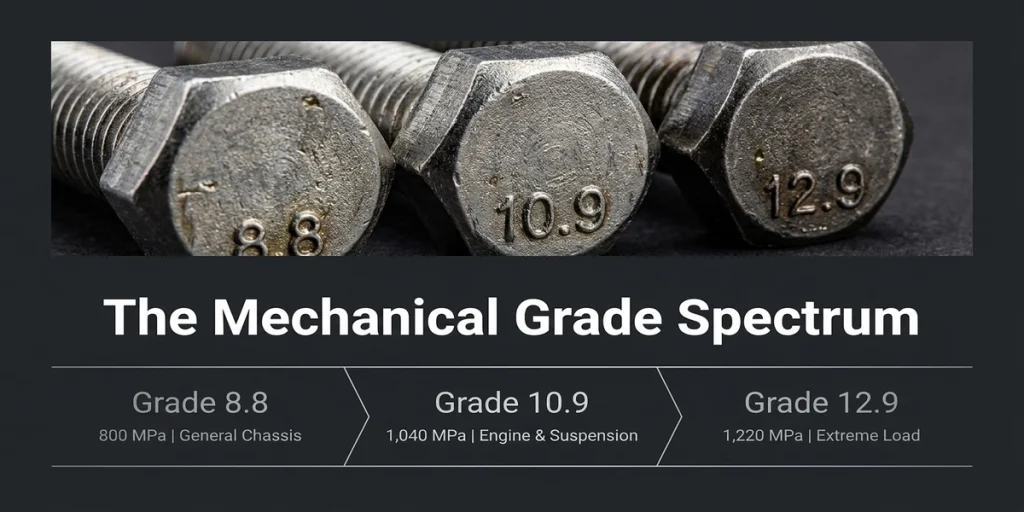
When selecting standard bolt grades, you can consider the following capacities:
| Nota | Estimated Tensile Strength | Estimated Yield Strength | Common Automotive Application |
| 8.8 | 800 MPa | 640 MPa | General chassis, non-critical joints |
| 10.9 | 1,040 MPa | 940 MPa | Engine, suspension, drivetrain |
| 12.9 | 1,220 MPa | 1,100 MPa | Extreme load conditions |
What Are the Selection Criteria for Vehicle Modules?
Selection criteria differ drastically across powertrain, chassis, and interior modules. Each vehicle zone presents unique stress factors and environmental exposures. Engineers must tailor their approach to these specific mechanical conditions. Over-specifying bolt grades without understanding the environment creates hidden risks.
Powertrain and Engine Modules
Engine components operate in extreme thermal zones reaching 150-300°C. Thermal expansion can quickly reduce clamping force if not managed. Standard zinc plating degrades rapidly at these elevated temperatures. Engineers prioritize phosphate coatings specifically for consistent friction control.
Chassis and Suspension Systems
Suspension modules face dynamic impacts and continuous vibration loads. These exact conditions make joints highly susceptible to loosening. Grade 10.9 alloy steel bolts are the default choice here. High-strength bolts require specific anti-loosening design features to maintain preload.
Interior and Cockpit Components
Interior joints often experience lower mechanical loads than chassis systems. However, you may still want the best fastening solutions for cockpit components and automotive interiors. For instance, you may need heat-resistant automotive fastening solutions for vehicle interiors. In this case, cost optimization and assembly speed may drive your choices.
Electric Vehicle Battery Packs
EV battery packs require specific safety and sealing considerations. Enclosure seals must lock out water and prevent moisture ingress. Bolts must hold clamp load through thousands of thermal cycles. Fasteners here demand rigorous ISO 26262 functional safety compliance.
How Do Assembly and Costs Impact the Choice?
Assembly constraints and total costs dictate the final automotive fastener solution. Fastener prices often represent only 30-50% of the total cost. Installation time and automation compatibility add significant operational expenses. Warranty claims from poor preload control easily dwarf initial part savings.
Assembly Automation Guidelines
The automotive fastening assembly equipment market requires standardized bolt sizes. Modern vehicle production relies heavily on robotic tightening systems. If tools cannot engage properly, preload cannot be consistently controlled. Consider the following technical requirements for assembly design:
- Ensure straight-line tool access to maintain torque precision.
- Use consistent fastener orientations for pick-and-place robots.
- Minimize fastener variety to reduce tool changeovers.
- Implement physical error-proofing features like unique sizes for critical joints.
Torque Control and Friction
Torque control alone produces preload variations of 25-30%. Friction coefficients fluctuate based on coating inconsistency or lubrication. This variation is a massive source of field performance risk. Torque-angle tightening provides more consistent preload than torque-only methods.
Why Select CNRL for Your Automotive Fastener Needs?
CNRL serves as an experienced Tier 1 and Tier 2 supplier for global automotive OEMs. Our 33,000-square-meter facility delivers precision components worldwide. We specialize in manufacturing parts that meet ISO/TS16949 standards. This certification ensures strict quality control across all production lines.
We produce custom solutions for automotive, wind energy, and construction industries. Our product range includes bolts, screws, nuts, and specialized helicoil inserts. We also manufacture custom stamping parts for battery energy storage systems. Our engineering teams provide Level 3 PPAP documentation for safety-critical components.
CNRL, seu fornecedor confiável de soluções em fixadores.
Soluções e consultoria profissional em fixadores para OEMs globais.
Obter uma cotaçãoConclusion: Your Trusted Manufacturing Partner
Our production process includes cold forming, thread rolling, and heat treatment. We retain master samples and checking aids for strict compliance. We partner with global brands like ZF, FAW, and Tenneco. Choose CNRL as your supplier for your next automotive fastener solution. Contate-nos to request a custom quotation today.
Procurar
Categorias
Etiquetas
Produto
- Aftermarket Fasteners
- Brake Caliper Rep Kits
- Camber Bolt
- Cylinder Bolt
- Tow Hook
- Truck Bolt & Nut
- Wheel Bolt
- Porcas de roda
- Fixador
- Parafuso
- Bronze pillar
- Buchas de bucha
- Cabide de escape Road
- Inserção Helicoil
- Chaves
- Nozes
- Alfinete
- Rebite
- Parafusos
- Peças de estampagem
- stud
- Máquina de lavar
- Automotivo
- Partes do corpo
- Sistema de freio
- Peças do chassi
- Peças do motor
- Peças de transmissão


