Metric vs. Imperial Automotive Fasteners: What Are the Risks of Mixing Them?
Metric and imperial fasteners use entirely different measurement systems. Mixing these thread types causes stripped threads and joint failure. Fastener mismatch destroys component integrity during automotive assembly processes. Always verify exact thread parameters before any installation.
What Are the Differences Between Imperial and Metric Automotive Fasteners?
Metric fasteners use millimeter dimensions for diameter and pitch under ISO standards. Imperial fasteners specify diameter in inches and measure threads per inch (TPI). These distinct measurement foundations prevent direct interchangeability between the two systems.
Modern vehicles globally utilize metric automotive fasteners for standardized assembly. Legacy American platforms often retain imperial automotive bolts and fasteners. While Unified National Coarse (UNC) and metric threads share a 60-degree angle, their pitches clash completely.
Understanding exact thread specifications requires referencing established international engineering standards. Metric systems follow ISO 261 for all coarse pitch threads. Imperial systems follow ASME B1.1 for standard Unified threads.
- Metric dimensions utilize an M prefix, nominal millimeter diameter, and millimeter pitch.
- Imperial dimensions utilize fractional inches for diameter and TPI for pitch.
- Metric grades utilize a number system indicating ultimate tensile strength.
- Imperial grades utilize SAE radial lines to denote material strength.
| Спецификация | Metric ISO Standard | Imperial UNC Standard |
| Base Unit | Millimeters (mm) | Inches (in) |
| Thread Angle | 60 Degrees | 60 Degrees |
| Pitch Measure | Distance between threads | Threads Per Inch (TPI) |
| Example | M10 x 1.5 | 3/8″-16 |
Why Is Mixing Fastener Standards Dangerous for Automotive Platforms?
Mixing standard systems causes immediate mechanical incompatibility during joint assembly. A metric nut on an imperial bolt will cross-thread and rapidly seize. This dangerous action strips the tapped hole and ruins the automotive screws fasteners.
Multinational automotive platforms often undergo localization during regional manufacturing transitions. Engineers might accidentally substitute metric automotive fasteners into imperial tapped holes. This exact mistake creates a severe near-miss scenario on the assembly line.
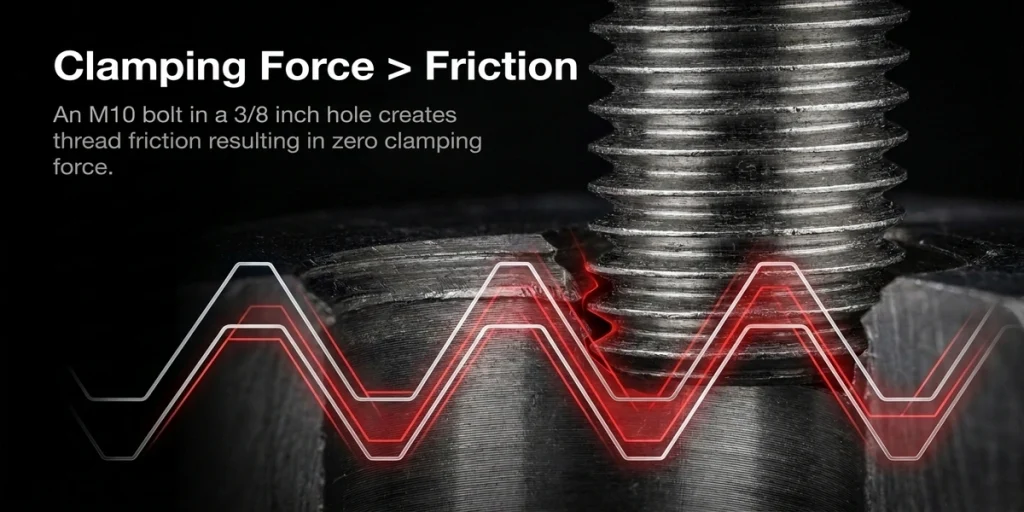
For instance, an M10 bolt threaded into a 3/8″-16 UNC hole feels tight initially. However, the mismatched pitch generates zero actual clamping force for the joint. Cyclical automotive vibrations will rapidly induce fatigue failure in this weak connection.
Thread stripping is gradual and not always detectable during initial assembly. A partially sheared thread retains the nut but loses crucial load capacity. Under heavy dynamic loads, this compromised connection will inevitably shear completely.
The table below shows examples of results of fastener assembly mismatch:
| Metric Fastener | Imperial Tapped Hole | Diameter Gap | Result of Assembly Mismatch |
| M8 x 1.25 | 5/16″-18 UNC | 0.06 mm | Seizes after 2-4 turns; strips parent thread completely. |
| M10 x 1.5 | 3/8″-16 UNC | 0.475 mm | Locks tight but yields zero clamping force. |
| M12 x 1.75 | 1/2″-13 UNC | 0.70 mm | Severe thread geometry clash prevents proper thread engagement. |
How Do Thread Mismatches Affect Joint Integrity?
Joint integrity relies entirely on proper thread engagement length and pitch alignment. Too short an engagement causes catastrophic thread stripping under tension. Pitch differences consume thread clearance, causing binding and complete joint seizure.
Using wrong automotive screws and fasteners risks vehicle safety. The structural integrity of chassis components depends on precise clamping forces. A mismatched fastener cannot maintain this critical tension under operating stress.
Automotive suspensions endure constant vibration and severe thermal cycling daily. A mismatched thread creates localized stress concentrations within the fastener body. These stress risers accelerate crack propagation during standard vehicle operating conditions. Eventual fatigue failure happens without any prior visual warning signs.
Identifying Fastener Grades Accurately
Property classes dictate the yield and tensile strength of a fastener. A metric class 8.8 bolt has an 800 MPa ultimate tensile strength. It provides a 640 MPa yield strength for critical structural connections.
SAE Grade 5 serves a similar medium-strength role for imperial applications. It features three visible radial lines on the bolt head. Direct substitution without engineering approval risks total structural failure.
Engineers must understand proof load limits before selecting replacement hardware. Proof load defines the maximum elastic range of a threaded bolt. Tensioning beyond this specified limit causes irreversible plastic deformation. The fastener loses ductility and becomes completely nonrecoverable for future use.
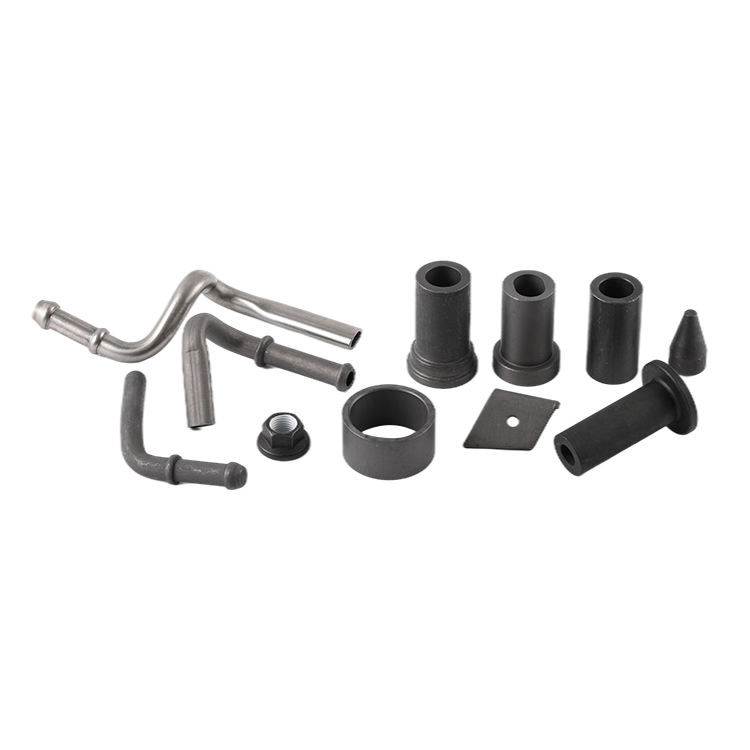
Крепежные элементы шасси легковых автомобилей и грузовиков, сертифицированные по стандарту IATF 16949: втулка, гайка, болт крепления выхлопной системы.
ПодробнееHow Can Precision Manufacturing Alleviate Compatibility Concerns?
Precision manufacturing eliminates dimensional variations that cause frustrating assembly issues. Factories must strictly control thread pitch and flank angles during production. Buyers need absolute assurance that automotive nuts bolts & fasteners will fit perfectly.
CNRL Manufacturing Capabilities and Certifications
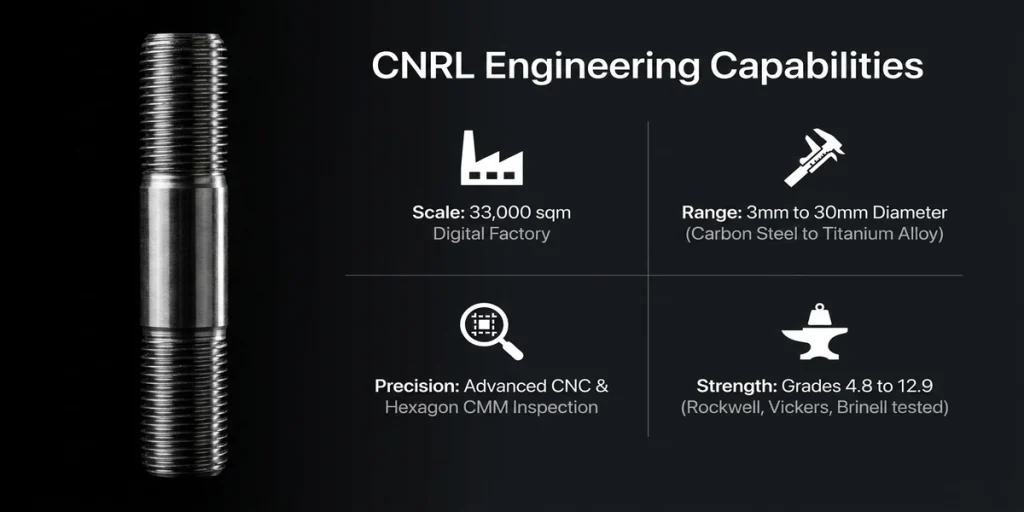
CNRL maintains exact control over all critical thread parameters. The company achieves this using Обработка на станках с ЧПУ and precision thread rolling equipment. Every batch undergoes strict Hexagon CMM inspection to guarantee absolute dimensional accuracy.
This exactness removes buyer anxiety regarding multinational platform integration. Consistent manufacturing prevents the fatigue failure risks associated with poor thread fitment. You can integrate metric automotive fasteners seamlessly into any modern assembly line.
CNRL operates a 33,000-square-meter facility with strict quality controls. Its production conforms to the ISO/TS16949:2016 industry quality standard. This certification ensures rigorous process management for every fabricated automotive part.
The factory supplies chassis, engine, and safety components globally. CNRL serves Tier 1 multinational clients including ZF, FAW, and TENNECO. Their custom fastener solutions support the automotive, wind energy, and oil sectors.
Заключение
Utilizing exact fastener standards is critical for automotive safety and longevity. Mixing metric and imperial threads guarantees joint fatigue and eventual mechanical failure. Partnering with an expert manufacturer eliminates these dimensional inconsistencies entirely.
Choose CNRL for your automotive production requirements today. Benefit from ISO-certified manufacturing, fast global delivery, and exact dimensional control. Ensure your assemblies remain secure under the toughest operating conditions.
Поиск
Категории
Теги
Продукт
- Aftermarket Fasteners
- Brake Caliper Rep Kits
- Camber Bolt
- Cylinder Bolt
- Tow Hook
- Truck Bolt & Nut
- Wheel Bolt
- Колесные гайки
- Застежка
- Болт
- Bronze pillar
- Втулки втулки
- Дорога для выхлопной трубы
- Вставка Helicoil
- Ключи
- Орехи
- Приколоть
- Заклепка
- Винты
- Штамповка деталей
- stud
- Стиральная машина
- Автомобильный
- Части тела
- Тормозная система
- Детали шасси
- Детали двигателя
- Детали трансмиссии


