Battery Fastener Requirements and Reliable Design Strategies for Battery Energy Storage Systems (BESS)
A simple BESS definition is Battery Energy Storage Systems. It stores energy from renewable or grid-based sources and releases it according to demand. BESS can be used for anything from utility substations to industrial microgrids.
Each battery energy storage system consists of many screws that secure battery cells, casings, and bus bars. Engineers often focus on cells and inverters. But the battery fastener is what keeps the entire assembly structurally sound and electrically stable.
Battery systems often fail and stop working because their connectors loosen, rust, or lose the ability to carry electricity. This guide covers the four core requirements and practical design strategies to prevent them.
What are the Core BESS Fastener Requirements?
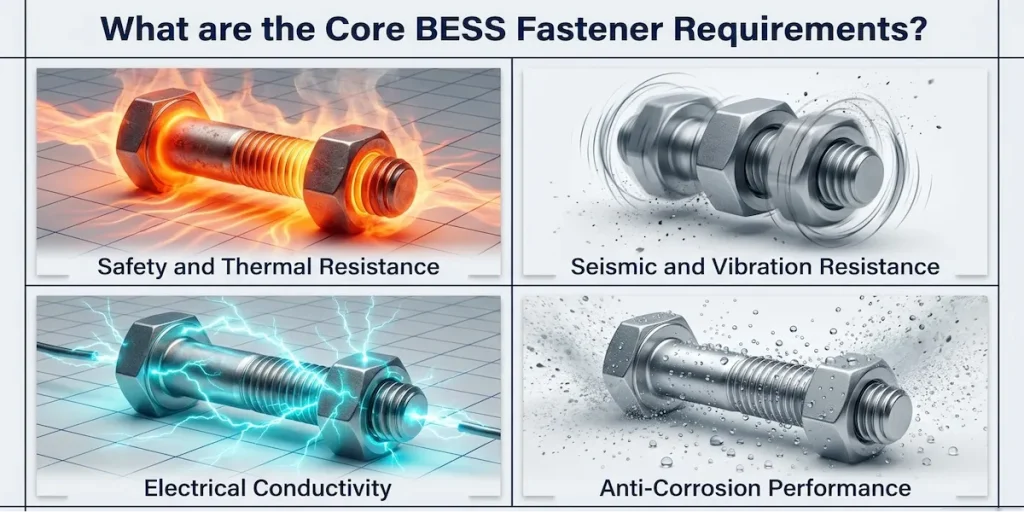
Battery pack fasteners are the backbone of battery storage. Here are some requirements to help you select a battery pack fastening design:
1. Safety and Thermal Resistance
BESS enclosures must contain heat and pressure during thermal runaway events. Fasteners at battery module connection joints must maintain clamping force above 200°C. Stainless steel grades A2-70 and A4-80 per ISO 3506 meet this threshold without creep or stress relaxation.
Choose fasteners with UL 9540A compliance for fire-rated BESS cabinet applications.
2. Seismic and Vibration Resistance
Large-scale BESS installations must comply with the IBC (International Building Code) for earthquake safety. The ESS structural bolts experience static seismic loads as well as dynamic vibration due to the cooling fans and grid switching.
You can use prevailing-torque nuts or thread-locking agents to create vibration-resistant fasteners. In environments with cyclic loads, these solutions reduce torque loss by as much as 40%.
3. Electrical Conductivity
Engineers usually choose nickel-plated copper or tin-plated brass for the connectors between battery cells and bus bars. These materials keep contact resistance below 0.5 mΩ, meeting IEC 62619 requirements for battery system safety.
Standard steel bolts can rust at the connection points, which blocks electricity and creates dangerous heat.
4. Anti-Corrosion Performance
Outdoor and coastal BESS installations require fasteners with a minimum 720-hour salt spray resistance per ISO 9227. Zinc-nickel coatings (8–12 μm) and geometry coatings outperform standard zinc plating in sustained humidity exposure.
What are the Structural Design Strategies for Battery Pack Fastening?
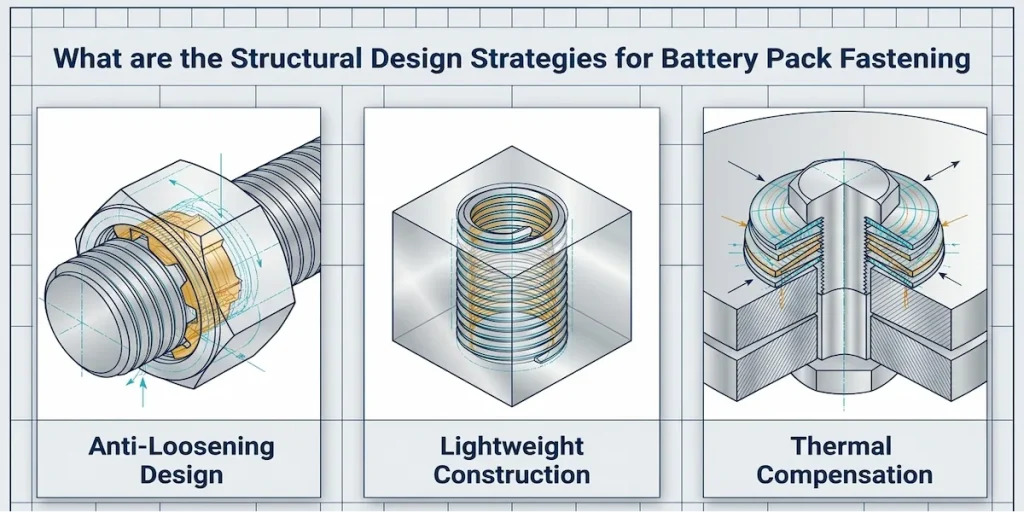
Additionally, you should also check the structural design of each battery module connection to ensure safety:
Anti-Loosening Design
Temperature swings between −20°C and +60°C cause metal expansion and contraction that loosen standard fasteners over time. An effective battery pack fastening design incorporates:
- Prevailing-torque hex nuts (ISO 7042) that resist rotation without adhesive;
- Belleville spring washers to maintain clamp load through thermal cycling;
- Thread-locking compounds for permanent joints in high-vibration zones.
Lightweight Construction
Every kilogram saved in a BESS enclosure improves energy density. Using Aluminum M6 bolts with Helicoil thread inserts achieves a 60 per cent weight saving compared to steel. Despite being lighter, these fasteners maintain a tensile strength of over 8 kN according to ASME B18.2 specifications.
Thermal Compensation
When different metals like steel bolts and aluminium frames are used together, they expand and shrink at different rates as temperatures change. Engineers specify torque values 10 to 15% above standard to compensate for differential expansion. They also recommend using spring washers at critical joints to sustain clamping pressure.
Recommended Product Solutions for BESS Applications
RL Fasteners supplies a dedicated battery pack product line through the CNRL system solution range. Key components include:
- ESS structural bolts: Grade 8.8 and 10.9 hex cap screws with zinc-nickel or geomet coating, available M4–M24;
- Prevailing-torque nuts: ISO 7042 compliant, stainless A2/A4 grades for vibration resistant fasteners applications;
- Stamping parts: Custom bus bar clips and bracket plates engineered for battery module connection assemblies;
- Helicoil inserts: Wire thread inserts per ASME B18.29 for thread reinforcement in lightweight aluminium housings;
CNRL’s battery pack product lines support full system-level solutions — not individual components. Engineers receive coordinated specifications for bolts, nuts, inserts, and stamped parts across the entire BESS assembly.
Why Partner with RL Fasteners for Your BESS Project
A BESS demands fasteners engineered for safety, conductivity, seismic loads, and corrosion resistance simultaneously. Selecting the wrong battery fastener costs time, money, and system uptime.
RL Fasteners manufactures and exports to BESS OEMs and EPC contractors across North America, Europe, and Asia-Pacific. Our factory holds ISO 9001:2015 certification, and our products comply with RoHS directives, IFI standards, and applicable CE and UL marks.
Our CNRL product line covers every joint in your battery energy storage system, from cell-level conductive fasteners to structural enclosure bolts.
Frequently Asked Questions
Q1: Why do standard bolts fail in BESS installations during temperature cycling?
Standard steel bolts cannot handle the constant heating and cooling of a battery system. This mismatch causes the bolts to loosen over time at the connection points. To ensure long-term reliability, use vibration-resistant fasteners like spring washers and prevailing-torque nuts that adjust for temperature changes.
Q2: What fastener materials perform best in outdoor or coastal BESS environments?
Stainless steel and zinc-nickel-coated fasteners resist rust in marine and outdoor environments. For electrical connections, nickel-plated copper alloys keep resistance low while stopping oxidation, which is vital for bolts exposed to humid or salty air.
Q3: Can Helicoil inserts improve battery pack fastening design in aluminium BESS housings?
Yes. Helicoil inserts strengthen threads in aluminium housings to prevent them from stripping during assembly. They allow lightweight materials to hold heavy pressure safely. This ensures the battery system stays structurally sound.