Gasket vs Washer: Understanding the Functional Differences for Sealing and Fastening
Washers and gaskets look almost the same. Both are flat, both have a hole in the middle, and both end up somewhere between a bolt and a surface. So it’s easy to see why engineers and procurement teams sometimes treat them as interchangeable.
They’re not. Using the wrong one in the wrong place leads to leaks, loose fasteners, and failures that are annoying at best and costly at worst. Here’s what actually separates the two, and why it matters in real applications.
What Is a Washer?
A washer is a thin, disc-shaped component designed to work with a fastener. Its main job is to distribute the clamping force of a bolt or screw over a wider surface area. Without a washer, all that force concentrates on a small contact point. That can crush softer materials, cause the fastener to bite into the surface, or create uneven pressure that leads to loosening over time.
Beyond load distribution, washers serve a few other purposes. They reduce vibration-induced loosening, act as spacers when needed, and in some cases prevent galvanic corrosion between a fastener and a dissimilar metal surface. What they generally don’t do, unless specifically designed for it, is prevent fluid or gas from leaking.
Washers are almost always made of metal: carbon steel, stainless steel, aluminum, brass, or copper, depending on the application. They’re rigid by design because rigidity is what makes load distribution work.
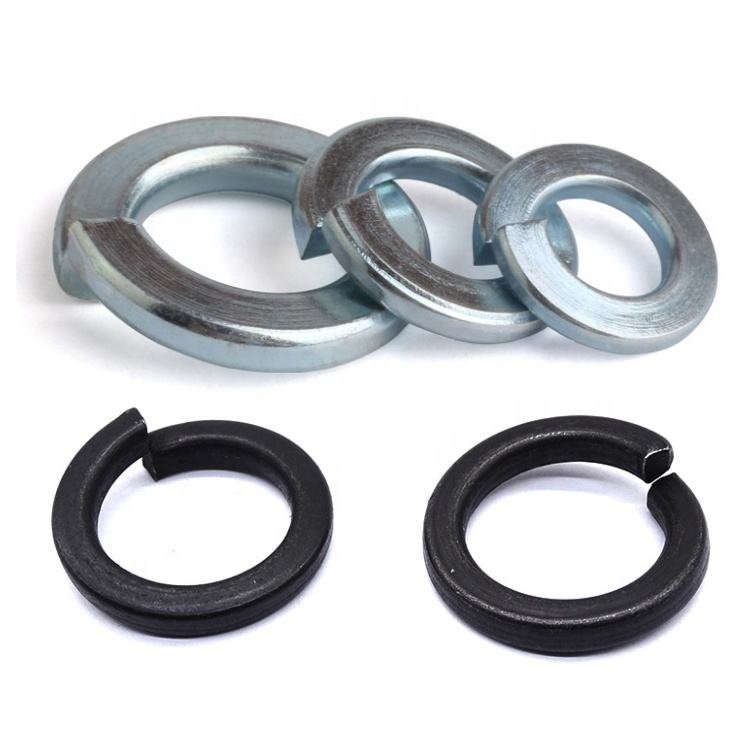
DIN127 Black Split Spring Lock Washers
More DetailsTypes of Washers
- Flat washers are the standard type. Its plain discs are used for load distribution in most general fastening applications.
- Lock washers are designed to resist loosening under vibration. The spring or serrated design bites into the fastener and surface to maintain tension.
- Spring washers maintain tension and absorb shock in assemblies that experience dynamic loading.
- Sealing washers (washers with rubber gaskets) combine a metal washer with a bonded rubber ring. This gives you load distribution and a localized seal around the fastener hole simultaneously—a useful combination in applications like automotive body panels, HVAC systems, and outdoor electrical enclosures.
What Is a Gasket?
A gasket is a sealing device. Its job is to fill the gap between two mating surfaces and prevent fluid or gas from leaking through. When two metal flanges are bolted together, their surfaces aren’t perfectly flat. There are microscopic irregularities and sometimes larger gaps. A gasket fills those gaps by compressing under pressure.
Gaskets are made from softer, more compliant materials than washers—rubber, PTFE, cork, silicone, compressed fiber, and, in high-pressure or high-temperature applications, spiral-wound metal or solid metal ring gaskets. That compliance is intentional. A gasket needs to deform slightly to fill surface irregularities. A rigid gasket can’t do that.
Gaskets are not typically used with individual fasteners the way washers are. They sit between flanges, pipe connections, engine components, pump housings, and any other assembly where a pressure-tight interface is required.
Types of Gaskets
- Sheet gaskets are cut from flat material—rubber, cork, or fiber—and suit a wide variety of shapes and connection types.
- Spiral-wound gaskets combine a metal strip with a filler material and are used in high-pressure, high-temperature pipeline and industrial applications.
- O-rings are circular seals used in both static and dynamic applications, from hydraulic systems to plumbing connections.
- Custom molded gaskets are engineered for specific component geometries where standard shapes don’t apply.
Gasket vs Washer: The Core Difference
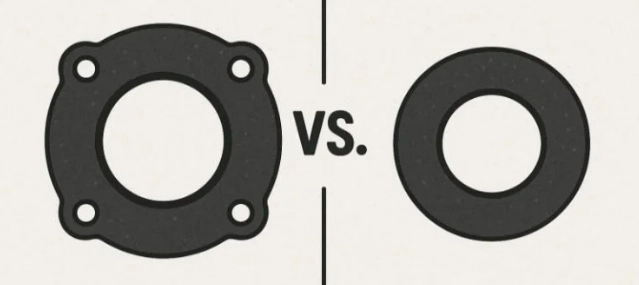
The distinction comes down to function. A washer supports the fastener. A gasket seals the joint.
| Feature | Washer | Gasket |
|---|---|---|
| Primary function | Load distribution | Sealing |
| Used with | Bolts, screws, nuts | Flanges, mating surfaces |
| Material | Typically metal (rigid) | Typically soft/compliant |
| Leak prevention | Not designed for sealing | Specifically designed to prevent leaks |
| Shape | Circular | Circular or custom |
| Reusability | Often reusable | Depends on material and application |
In some cases the functions overlap. A washer with a rubber gasket provides both load distribution and a localized fluid seal around a fastener. They are also called a sealing washer or bonded washer. These are common in roofing fasteners, automotive applications, and any installation where a bolt passes through a panel and a watertight seal is required at that point.
Why This Matters for Design Engineers
In automotive chassis and new energy vehicle applications, both washers and gaskets appear in the same assembly—often close together.
Chassis bushings, suspension mounts, and battery enclosures use hardened washers to distribute clamp load without deforming the surrounding structure. Sealing elements at fluid connections, sensor ports, and enclosure interfaces use gaskets to maintain pressure integrity.
Specifying the wrong component in either role creates problems. A gasket used where a rigid washer is needed won’t maintain the correct clamp load. The compressible material deforms unpredictably under torque. A standard washer used where a gasket is needed does nothing to prevent leakage.
Material hardness is a key specification for washers in load-bearing applications. Rockwell Hardness values, typically HRC 26–35 for carbon steel hardened washers in automotive use, determine whether the washer can withstand the clamping force without yielding.
CNRL’s washer range is developed with this requirement in mind, drawing on experience from OEM collaborations including FAW, Volkswagen, and Daimler, where sealing and fastening performance demands are among the most stringent in the industry.
Frequently Asked Questions
Can a washer replace a gasket?
Not in sealing applications. Standard metal washers don’t prevent fluid or gas leakage. If sealing is the requirement, you need a gasket or a sealing washer with a bonded rubber element.
What is a washer with a rubber gasket used for?
A sealing washer (a metal washer bonded with rubber) provides both load distribution and a localized seal around a fastener hole. It’s used in roofing, automotive panels, HVAC, and outdoor electrical applications where water ingress at the fastener point must be prevented.
What do “washers” and “gaskets” mean in an automotive context?
In automotive assemblies, washers are used to distribute bolt load at suspension, chassis, and body attachment points. Gaskets seal fluid connections, engine components, and enclosures. Both are present in most complex automotive assemblies, but they serve different purposes.
How do I know if I need a gasket or a washer?
Ask one question: is the requirement to secure a fastener or to seal a joint? If you’re torquing a bolt, you need a washer. If you’re preventing leakage between two mating surfaces, you need a gasket. If both are required at the same point, a sealing washer handles both.What hardness should automotive washers have? Hardened washers for automotive structural applications typically fall in the HRC 26–35 range, though exact requirements depend on the fastener grade, clamp load, and substrate material. Consult the relevant automotive standard or OEM specification for the specific application.


