What Documents Are Required for Fastener PPAP? 18 Detailed Explanations
When an automotive OEM or Tier 1 supplier asks for a PPAP submission, they’re not asking for a favor. They’re asking for proof.
Proof that your production process understands the design requirements, controls the key variables, and can consistently produce fasteners that meet specifications—every run, not just the first one.
PPAP stands for Production Part Approval Process. It was developed by the Automotive Industry Action Group (AIAG) to create a standardized approval process across the automotive supply chain. The current reference is the AIAG PPAP Manual, 4th Edition.
For fastener suppliers serving automotive OEMs, PPAP is a standard requirement. The ability to deliver a complete, accurate package on request is one of the clearest signals of supplier quality maturity.
Here’s what each of the 18 elements actually is, and why it matters.
The 18 PPAP Documents Explained
1. Design Records
A copy of the customer’s engineering drawing or CAD model. Every feature on the drawing must be marked. Each one must match inspection results. For fasteners, this includes thread form, head shape, shank size, strength, and surface treatment. Everything must be documented and traceable.
2. Authorized Engineering Change Documents
Any approved changes to the original design must be documented here, with the full Engineering Change Notice (ECN) or deviation approval attached. If the hole diameter changed, the thread class was updated, or the surface treatment was modified, that change must be authorized and recorded before it can be incorporated into the PPAP submission.
3. Customer Engineering Approval
The customer’s engineering team provides written confirmation that sample parts were reviewed and approved. For fasteners used in safety-critical applications—like structural joints, brakes, and suspension mounts—this step shows the engineers have checked and validated the part’s function.
4. Design Failure Mode and Effects Analysis (DFMEA)
The DFMEA shows all the ways a fastener’s design could fail. Failures include low tensile strength, fatigue fracture, thread stripping, or corrosion. Each failure is rated for severity, likelihood, and detection. Risk priority numbers (RPN) are assigned. For standard designs, the customer usually provides the DFMEA. For custom fasteners, the supplier creates it..
5. Process Flow Diagram
A visual map of the complete production sequence from raw material receiving through shipping. For fasteners, this typically covers a process. The process includes incoming material inspection, wire/bar drawing or cutting, cold forming or hot forging, thread rolling, heat treatment, surface treatment, dimensional inspection, packaging, and dispatch. The flow diagram must match the actual process and not just an idealized version.
6. Process Failure Mode and Effects Analysis (PFMEA)
Where the DFMEA addresses design failure, the PFMEA addresses process failure. It identifies every step in the process flow where something can go wrong. For example, incorrect forming die, heat treatment temperature deviation, contaminated plating bath, gauge out of calibration. It also documents controls to prevent or detect each failure mode. The PFMEA must be kept current as processes change.
7. Control Plan
The control plan is the operational document that translates the PFMEA into daily production practice. It specifies which characteristics are monitored, how they’re measured, at what frequency, and what the reaction plan is if a measurement goes out of specification. For fasteners, control plans typically cover incoming material hardness, formed dimensions, thread gauging, heat treatment temperature and time, coating thickness, and final dimensional inspection.
8. Measurement System Analysis (MSA)
An MSA study evaluates the measurement systems used to generate the inspection data in the PPAP. The question is whether variation in the measurement system itself is small relative to the specification tolerance. For fastener inspection, each measurement system used for critical characteristics must have a completed MSA study showing acceptable Gage R&R values.
9. Dimensional Results
Actual measurement data from a defined sample of production parts. Typically 30 pieces from a production run, with every characteristic from the drawing measured and recorded. Results are compared to the drawing tolerances, and each characteristic is reported as conforming or non-conforming. Cpk values for critical dimensions should be calculated where sufficient data exists.
10. Records of Material and Performance Test Results
Material test reports show the fastener meets its specifications. This includes tensile strength, yield strength, proof load, and hardness (Vickers or Rockwell). Some applications also require impact toughness or fatigue strength. For coated fasteners, tests include salt spray results, coating thickness, and, for high-strength parts, hydrogen embrittlement data.
11. Initial Process Studies
Statistical process capability data showing that the production process is stable and capable. Cpk values of 1.67 or higher are commonly required for critical characteristics during PPAP—indicating that the process is performing well within specification limits with adequate margin. If capability is below that threshold, the customer and supplier must agree on an action plan.
12. Qualified Laboratory Documentation
All testing performed for PPAP must be done in qualified laboratories. Internal laboratories must demonstrate compliance with ISO/IEC 17025 or equivalent. External test houses must be accredited. The PPAP package must include documentation confirming the accreditation status of any lab that generated test data in the submission.
13. Appearance Approval Report (AAR)
For fasteners with appearance requirements—like visible trim, colored coatings, or special surface finishes—the AAR shows the customer has reviewed and approved them. For standard industrial fasteners without appearance needs, this step may not apply.
14. Sample Production Parts
Physical fastener samples from the production run. The number of samples required depends on the PPAP submission level (typically 1 to 5 pieces for customer retention). These are production parts—not hand-selected samples or prototype-produced parts.
15. Master Sample
A reference fastener retained by the supplier and signed off by the customer, used as the benchmark for future production comparisons. When production deviates or questions arise about specification compliance, the master sample is the reference point.
16. Checking Aids
Documentation of any gauges, fixtures, or test equipment specific to this part number. Custom thread gauges, profile gauges, or assembly fixtures are used in final inspection. The checking aids must be calibrated, and their calibration records retained.
17. Customer-Specific Requirements
A catch-all element that documents compliance with any requirements in the customer’s supplier quality manual that go beyond the base AIAG PPAP requirements. Major OEMs—Volkswagen, Daimler, Ford, and GM—all publish customer-specific requirements. This element is the evidence that the supplier read, understood, and implemented those requirements. Missing or incomplete CSR compliance is one of the most common PPAP rejection reasons.
18. Part Submission Warrant (PSW)
The PSW is the cover document for the entire PPAP package. It summarizes the submission. This includes the part number, revision level, and reason for submission (new part, engineering change, or annual revalidation). It also shows the PPAP submission level and the normal number of parts produced per shift. The supplier quality representative signs the PSW, certifying that the package is complete and accurate. The customer quality representative signs it to grant approval.
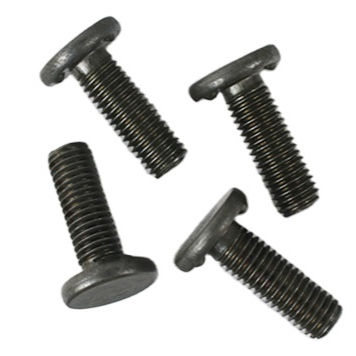
Fastener bolt weld flange bolt customized welding bolt
More DetailsPPAP Submission Levels
Not every PPAP requires all 18 elements to be submitted to the customer. The level determines what goes to the customer versus what stays on file at the supplier:
- Level 1: PSW only (retained documents at supplier)
- Level 2: PSW plus limited supporting data and samples
- Level 3: PSW plus complete supporting data and samples—the industry default
- Level 4: PSW plus other requirements as specified by the customer
- Level 5: PSW plus complete supporting data reviewed at the supplier’s facility
Most automotive OEMs default to Level 3. The supplier must complete all 18 elements regardless of submission level. It is the level that only determines what gets sent to the customer.
What a Complete PPAP Says About a Fastener Supplier
A fastener supplier who can deliver a complete, accurate Level 3 PPAP package on request has demonstrated something specific: that they understand the customer’s design requirements, that their processes are documented and controlled, that their measurement systems are qualified, and that their quality system produces reliable data.
That’s the signal high-end OEM buyers are looking for. It’s also what separates a serious supplier from a low-tier operation that can quote a price but can’t support the qualification process.CNRL Fasteners maintains 100% full-process inspection records and is capable of delivering a complete 18-element PPAP package for fastener submissions. This capability is part of what supports partnerships with OEMs and component suppliers, including FAW, Audi, Daimler, ZF, and Tenneco.
Frequently Asked Questions
What does PPAP stand for in manufacturing?
PPAP stands for Production Part Approval Process. It’s a standardized quality assurance process used primarily in the automotive supply chain to confirm that a supplier’s production process can consistently produce parts meeting customer requirements.
Is PPAP required for all fasteners supplied to automotive OEMs?
PPAP is required for new parts, parts with engineering changes, or parts produced from new or significantly revised processes. Standard catalog fasteners supplied as commercial off-the-shelf (COTS) parts may be handled at Level 1, but this is negotiated with the customer. Safety-critical fasteners typically require full Level 3 PPAP.
How long does a PPAP submission take to prepare?
For a single fastener part number with an existing quality system, a complete Level 3 PPAP typically takes two to four weeks to prepare—including the production run for sample parts and capability data. Complex parts or new tooling may extend that timeline.
What happens if a PPAP is rejected?
The customer issues rejection findings identifying specific deficiencies. The supplier must address each finding, make corrections, and resubmit. Major nonconformances in PFMEA, control plans, or capability data can require significant process changes before resubmission is viable.
What is the fastener PPAP submission level typically required by OEMs?
Level 3 is the industry default—PSW with product samples and complete supporting data. Some customers require Level 5 for critical safety parts (review at the supplier’s manufacturing facility). Level 1 may be accepted for low-risk standard parts with an established supply history.
Search
Categories
Tags
Product
- Aftermarket Fasteners
- Brake Caliper Rep Kits
- Camber Bolt
- Cylinder Bolt
- Tow Hook
- Truck Bolt & Nut
- Wheel Bolt
- Wheel Nuts
- Fastener
- Bolt
- Bronze pillar
- Bushing Sleeves
- Exhaust Hanger Road
- Helicoil Insert
- Keys
- Nuts
- Pin
- Rivet
- Screws
- Stamping Parts
- stud
- Washer
- Automotive
- Body Parts
- Brake System
- Chassis Parts
- Engine Parts
- Transmission Parts


