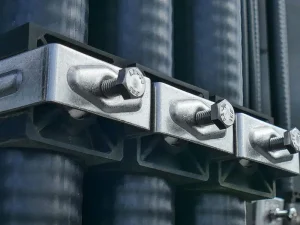
Stud Bolts for Flanges: The Wind Turbine Fastener That Holds It All Together
Wind turbines produce millions of watts of energy through a clean process. The stud bolt is a small component that holds the turbines together. All segments of the tower, the nacelle, and the hub are connected using bolted ring flanges. Choosing the wrong fastening element will cause failure of the whole assembly.
This article discusses why stud bolts are appropriate wind turbine fasteners. You will also learn how to source stud bolts for flanges from stud bolt suppliers.
Why is the Tower/Hub Connection the Most Critical Bolted Joint?
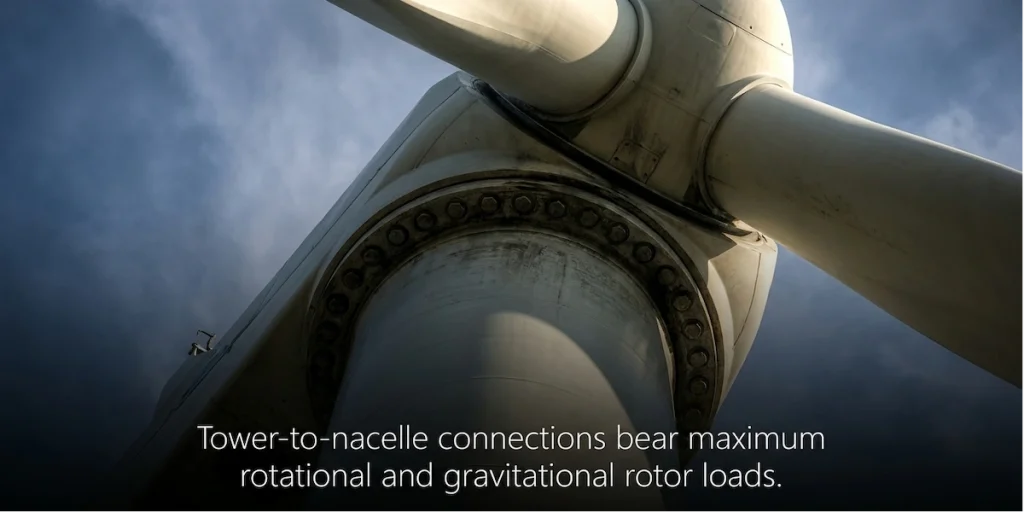
The tower-to-nacelle connection carries the full rotational and gravitational load. This load is generated by the rotor, blades, and drivetrain. It is the single most stressed bolted flange on a wind turbine. The hub-to-blade and hub-to-main-shaft interfaces rely on bolted flange design to transfer extreme aerodynamic loads to the foundation.
The wind turbine flange joint is installed using 100 or more wind turbine bolts pre-tensioned to more than 640 kN.
These connections must withstand:
- Dynamic Fatigue: Constant vibration and oscillating wind loads.
- Environmental Corrosion: Salt spray in offshore sites or extreme temperature fluctuations in high-altitude plains.
- Tensile Stress: Thousands of kilonewtons of force attempting to pull the flange faces apart.
Selecting specialized wind turbine fasteners is the only way to maintain the necessary clamping force over a 25-year service life.
What are the Differences Between a Stud Bolt vs. Threaded Rod?
A stud bolt and a threaded bolt may look similar. However, there is a significant engineering distinction between a dedicated stud bolt and a standard threaded rod in wind applications.
Refer to the table below that summarizes the features of a stud bolt vs. a threaded rod:
| Feature | Stud Bolt (Recommended) | Full-Threaded Rod |
| Stress Distribution | Optimized via unthreaded shank options to reduce fatigue. | Threads act as “stress risers” along the entire length. |
| Material Grade | Typically Grade 10.9 or 12.9 high-strength steel. | Often lower carbon steel grades. |
| Precision | Tight tolerances for flange alignment. | General-purpose tolerances. |
For critical infrastructure, high-strength stud bolts offer superior elastic elongation properties. These bolts are essential for maintaining preload under thermal expansion.
How Do You Ensure Preload Control and Sealing Safety?
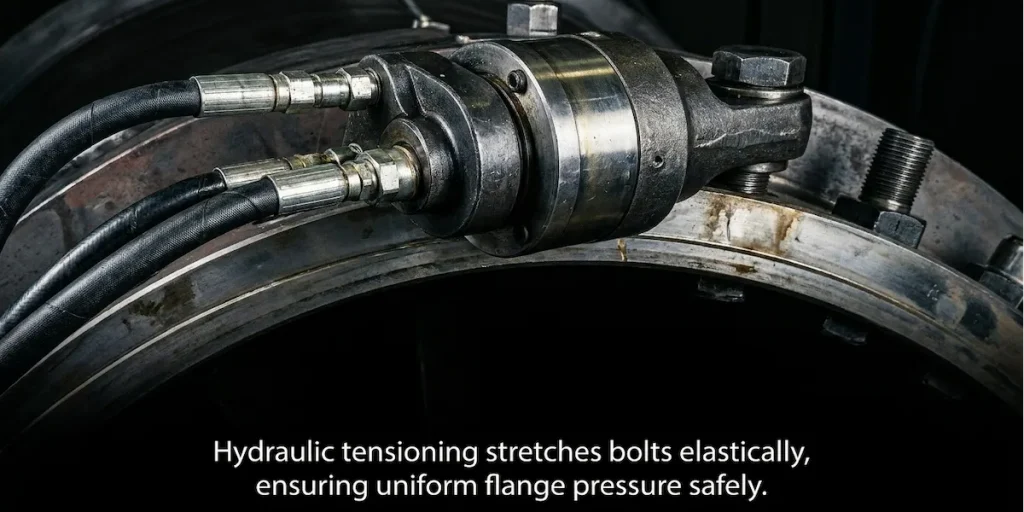
Maintaining the integrity of a fastener with a flange requires precise preload management. If the preload is too low, the connection will loosen due to vibration. Consequently, if it is too high, the bolt may exceed its yield strength.
Preload Strategies
- Hydraulic Tensioning: This is the preferred method for stud bolts for flanges. It stretches the bolt elastically before the nut is tightened, ensuring uniform pressure across the flange face.
- Torque Control: This process is utilized for smaller secondary fasteners, though it is subject to friction variances.
- Testing Protocols: Engineering teams use the best bolt testing tools for wind turbines, such as ultrasonic stretch measurement. This is used to verify that every fastener meets the specified Mega-Pascals (MPa) of tension.
Real-World Industrial Applications
In 2.5MW to 10MW turbines, wind turbine bolt sets are deployed in several key areas:
- Foundation Bolts: These bolts are used for anchoring the base tower section to the concrete pad.
- Yaw System: This system connects the nacelle to the tower to allow for wind tracking.
- Blade Root: This component secures the composite blades to the pitch bearings.
Reliable stud bolt suppliers must provide full traceability and EN 10204 3.1 certification to ensure these components meet ISO 898-1 mechanical requirements.
CNRL Recommended Products
CNRL provides engineered fastening solutions designed for the rigors of the energy sector. We provide the following recommended stud bolts and nuts:
- High-Strength Stud Bolts: Available in 42CrMo4 alloy steel with Geomet or Hot Dip Galvanized (HDG) coatings for C5-M offshore corrosion resistance.
- Heavy Hex Nuts: Precisely matched to stud strength grades to prevent thread stripping under maximum load.
Conclusion: The CNRL Advantage
Choosing CNRL means partnering with a specialist in flange applications. Our experience in high-capacity stud product lines ensures that your wind project benefits from fasteners that exceed international safety standards. We provide the technical documentation and high-performance hardware required to keep your turbines turning safely in the most demanding environments.
Frequently Asked Questions (FAQs)
Q1: Can a standard threaded rod replace a stud bolt in a wind turbine flange connection?
No. Threaded rods lack the material certification, dimensional tolerances, and thread engagement depth required for bolted flange design in wind turbine applications. High-strength stud bolts manufactured to ASTM A193 B7 or ISO 898 are the minimum specified standard for these joints.
Q2: How often should stud bolts in wind turbine flange connections be re-tensioned?
Industry practice calls for re-tensioning 10% of wind turbine bolts annually. Research on offshore flange connections shows that tension-controlled bolts achieve a stable preload state within the first four years. After that initial period, inspection intervals can be safely extended.
Q3: What is the risk if the stud bolt preload is not verified after installation?
Under-tensioned stud bolts allow bolt loosening under cyclic load. In documented failures, bolts at less than 30% residual axial tension reduced joint fatigue life from 21 years to under 3 months. Proper tensioning and verification with calibrated bolt testing tools is non-negotiable.