EV Chassis Fasteners: High-Strength Fasteners for your Vehicle
Fasteners required by electric vehicles surpass those used by internal combustion (ICE) vehicles in every aspect. This includes 600 kg of battery pack weight, an immediate high torque output provided by a permanent magnet motor, and the relentless thermal cycle.
EV chassis fasteners serve as a safety-critical component. The wrong bolt, pin, or bushing not only wears out but can also lead to mechanical failure.
This article explains which fastener types matter most in EV chassis and suspension systems. It also explores the recommended use for each fastener category.
Why Do EV Chassis Fasteners Carry Greater Load Than ICE Equivalents?
Three primary factors of electric vehicle design increase the load on critical fasteners:
- Battery mass: A lithium-ion pack for a mid-size EV sedan weighs 400 to 900 kg. This low-mounted mass increases the bending moment on suspension fasteners and subframe attachment points by 30 to 50% compared to similar ICE platforms.
- Instant torque delivery: Electric motors produce peak torque from 0 RPM. Launch and regenerative braking spike shear forces on chassis connection bolts in ways combustion powertrains do not.
- Thermal cycling: Battery thermal management systems create repeated heating and cooling. Fasteners must maintain clamp load across aluminum and steel interfaces with different coefficients of thermal expansion.
These demands require specific high-strength fasteners. General-purpose hardware may cause the EV to fail.
What are the Four Critical Fastener Categories for EV Chassis and Suspension?
This section explores the different components required for manufacturing automotive industry high-strength fasteners in electric vehicles:
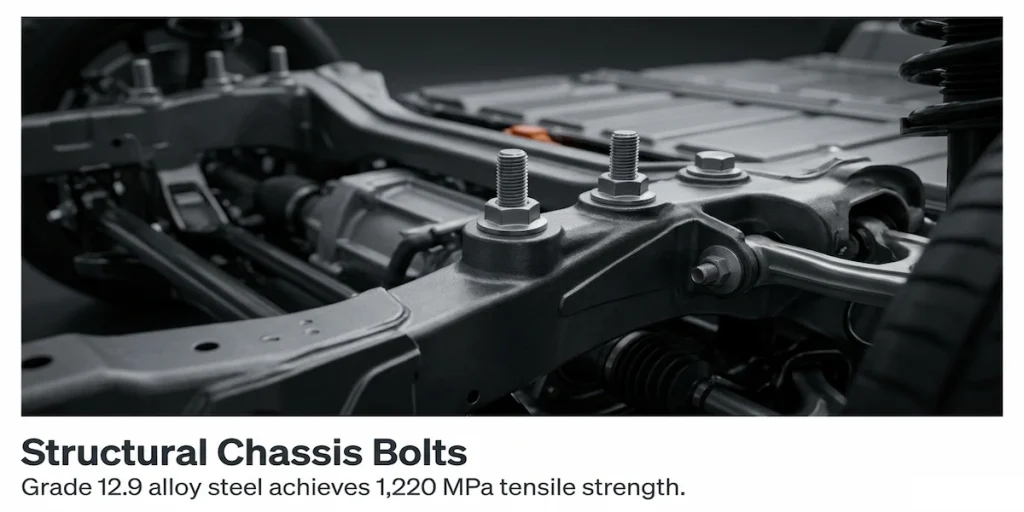
1. Structural Bolts and Chassis Connection Bolts
The chassis connection bolts secure the body-to-frame joints, subframe attachments, and motor mount brackets. These joints carry the full dynamic load of the vehicle.
Specify Grade 10.9 or 12.9 alloy steel (42CrMo4 per ISO 683-2) with zinc-nickel electroplating rated to 720 hours salt spray. This is according to ISO 9227.
High-strength fasteners in this class achieve a tensile strength of 1,040–1,220 MPa. This supports both static structural loads and dynamic fatigue cycling.
RL Fasteners supplies structural bolts in custom thread pitch, head geometry, and shank length to OEM drawings.
Our team supplied chassis connection bolts directly for Audi’s new energy vehicle (NEV) platform. This program requires surface finishes and dimensional tolerances tighter than standard DIN 933.
2. Suspension Fasteners
Suspension fasteners connect control arms, shock absorber towers, anti-roll bar brackets, and wheel hub carriers. On EV platforms, these joints carry greater static preload due to battery-floor integration.
EV suspension fasteners typically must meet fatigue life requirements of at least ≥10⁷ load cycles. These targets follow the ISO 1143 standards for rotating bending fatigue. A surface hardness of 32–40 HRC reduces fretting wear at mating interfaces.
The fastener for EV truck platforms often requires M16–M24 diameters and flanged heads for control arm pivots. This design distributes clamping loads across aluminum knuckles to prevent surface damage.
3. Automotive Pin and Bushing Assemblies
Automotive pin and bushing assemblies allow controlled articulation in multi-link and trailing-arm suspension geometries. They absorb shock, isolate NVH, and maintain suspension geometry under load. Below are the specific requirements:
- Pins: Hardened carbon steel (SCM435, 38–42 HRC), ground to h6 tolerance per ISO 286-1 for consistent press-fit retention.
- Bushings: Rubber-bonded steel or polyurethane, with torsional stiffness tuned to vehicle suspension frequency targets (typically 1.2–2.5 Hz natural frequency for passenger EVs).
RL Fasteners manufactures automotive pin and bushing assemblies based on customer drawings. We supplied these rear multi-link suspension components for NEV programs in addition to our Audi project work.
4. Battery Fasteners to the Car
Battery fasteners to the car are the bolts and studs that mount the battery enclosure to the vehicle floor structure. These are the most safety-critical fastener group in an EV. Enclosure separation during a crash or heavy vibration causes catastrophic failure.
Specify corrosion protection rated to 1,000+ hours salt spray (ISO 9227). Thread-locking features (serrated flanges or adhesive-patched threads) prevent loosening under NVH loads. Fastener material must accommodate thermal expansion of aluminum enclosures (CTE ≈ 23 µm/m·°C) without loss of clamp load over 10+ years of service.
We supply battery fasteners to the car in M8 to M16 socket head cap screws and hex flange bolts. These components feature custom coating systems designed specifically for NEV battery floor applications.
Conclusion
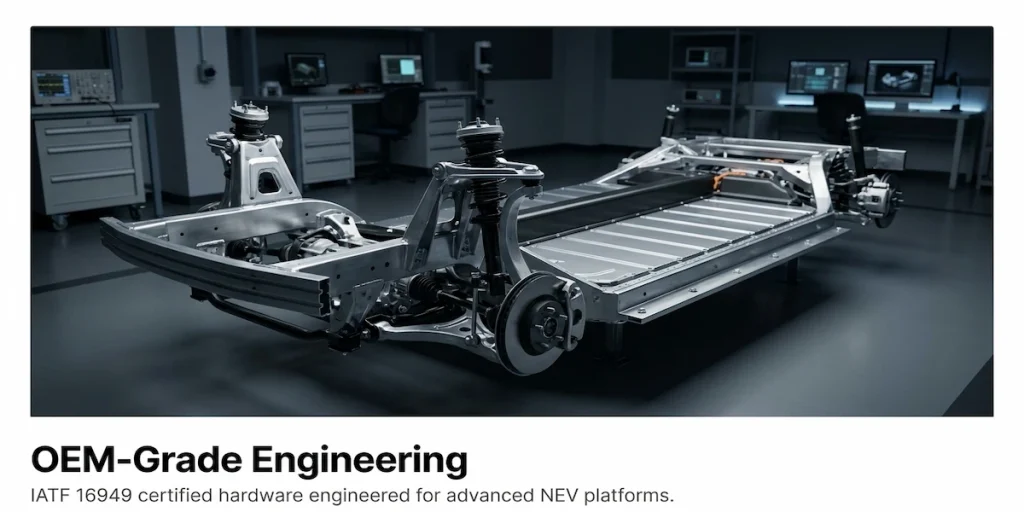
Every bolt, pin, and bushing in an EV chassis carries a safety obligation. EV chassis fasteners must meet mechanical, corrosion, and fatigue specifications that generic fastener catalogs rarely document clearly.
RL Fasteners manufactures and exports structural bolts, suspension fasteners, chassis connection bolts, automotive pin and bushing assemblies, and battery mount hardware to OEM-grade specifications.
Our direct involvement in the Audi new energy vehicle chassis program gives us first-hand application engineering experience that most distributors cannot offer.
Our fasteners are IATF 16949:2016 certified (automotive quality management system) and ISO 9001:2015 certified. We conduct in-house salt spray testing per ISO 9227. Our facility also performs tensile and proof load testing per ISO 898-1 and hydrogen embrittlement evaluation per ASTM F519.
Frequently Asked Questions
Q1: How did RL Fasteners resolve torque-scatter issues on an EV subframe bolt program?
On an NEV subframe project, we identified inconsistent friction coefficients causing ±22% torque scatter. We switched to a zinc-nickel + wax lubricant system. Scatter dropped to ±8%, meeting the OEM’s Cp ≥ 1.67 process capability requirement within two production batches.
Q2: What coating specification do you recommend for battery floor fasteners in high-humidity markets?
We specify Geomet 500B coating for markets with high salt exposure. This coating prevents hydrogen embrittlement and withstands 1,440 hours of salt spray per ISO 9227.
Q3: Can RL Fasteners supply automotive pin and bushing assemblies to custom suspension geometry tolerances?
Yes. We produced hardened steel pins ground to ISO 286-1 h5 tolerances for the Audi NEV chassis project. These pins feature rubber-bonded bushings that meet the OEM’s torsional stiffness target of 18 N·m/° at 25°C.