Bolt Preload Calculation: Why Does Bolt Preload Loss Cause Joint Fatigue in High-Vibration Automotive Applications?
Quick Answer:
The bolt preload is the tension induced in the fastener during its tightening. It compresses the parts that are joined and prevents their separation due to vibrations and applied loads. As preload reduces, the joint will start to move and open during each loading cycle. Therefore, the cyclic load is going to affect the bolt more, which will increase its stress level and lead to fatigue failure. The bolt preload calculation may help to determine the clamp force generated when a certain torque is applied. There are a lot of factors that may influence the process and cause significant variations. CNRL produces automotive fasteners for the engine, chassis, transmission, and other applications. The production system for the automotive industry is certified to the IATF16949 standard.
Why is preload the hidden force in an automotive joint?
A mechanical joint functions due to a fastener’s tension on the joined surfaces, which compresses them even before any load acts on the joint.
During the working of the system, vibrations, shocks of driving, engine motion, and variations of torque act on the joint. When preload exists in sufficient amounts, much of the load acts on the compressed components of the joint, not on the bolt.
It is important since fatigue is highly dependent on the stress range. A correctly preloaded joint maintains low additional cyclic stresses on the bolt.
What happens when preload is lost?
This process is quite predictable. Since preload decreases, clamping force between the joints diminishes. Thus, interface surfaces may slide or even separate when subjected to dynamic loads.
Greater load goes to the bolt either in the form of tension or bending. It results in increased stress levels that will cause fatigue or cracking.
It is particularly crucial in the areas of engine mountings, power train assemblies, suspension parts, exhaust system, and chassis connections.
What is bolt preload?
It is an axial tensile force that is induced in a bolt after tightening it. This tensile force will elongate the bolt slightly. The other phenomenon that occurs is that the two connected surfaces will be compressed by the bolt.
This compression will give rise to a load known as clamp force. In a simply loaded joint, the preload and the clamp force are equal in magnitude but opposite in direction.
Why preload affects fatigue
Sufficient preload ensures that the joint interfaces are compressed. This way, there will be no separation, and friction between the components will take care of most of the applied external loading.
In case the preload is too low, the joint will start opening and closing on each cycle. The load that the bolt takes will increase significantly.
The vibration of the joint can be an example of the cause of preload reduction. Crosswise motion can lead to rotational loosening of the joint interfaces and threads.
How is bolt preload calculated?
A basic bolt preload formula uses tightening torque, bolt diameter, and a nut factor:
Fi = T / (K × d)
Here, Fi is the estimated preload, T is tightening torque, K is the nut factor, and d is the nominal bolt diameter.
For example, consider an M12 class 10.9 bolt with a target preload of 50 kN. Using a nut factor of 0.20:
T = K × d × Fi
T = 0.20 × 0.012 × 50,000 = 120 N·m
Therefore, 120 N·m would estimate about 50 kN preload under the assumed conditions.
Why the calculation is only an estimate
Torque does not directly measure bolt tension. Much of the applied torque is consumed by thread and bearing friction.
The nut factor can change with lubrication, plating, and surface finish. The research notes that these changes can create significant preload errors, even when torque is carefully controlled.
For critical joints, engineers may use angle control or direct tension measurement. More detailed joint calculations can also consider thread geometry, friction, and joint stiffness.
What preload mistakes can cause joint problems?
Both insufficient and excessive preload can create problems. The correct value depends on the fastener, joint design, and service conditions.
Too little preload
Under-preloading reduces the frictional grip between the joint members. Vibration can then cause movement, loosening, and higher cyclic stress in the bolt. The result may be fatigue failure, joint separation, or leakage in sealed assemblies.
Too much preload
Excessive preload can push the bolt beyond its intended stress range. It may also damage threads or distort the connected parts. Using a higher-strength bolt does not automatically solve the problem. The joint must still be designed around the correct preload and load conditions.
Friction and assembly conditions
A common mistake is applying a generic torque value without considering the fastener’s actual surface condition.
For example, using a dry torque value on a lubricated fastener can produce much higher preload than intended. This is why torque specifications should match the specified fastener and assembly condition.
CNRLの bolt torque chart guide provides additional information on torque specifications.
カスタムメイドのM7 M12 M24ねじ付きボルト、ピン付きastmボルト
詳細情報How does CNRL support consistent automotive fastener performance?
A calculated preload is only useful when the fastener’s dimensions, 材料, 抗張力, and surface condition match the design requirements.
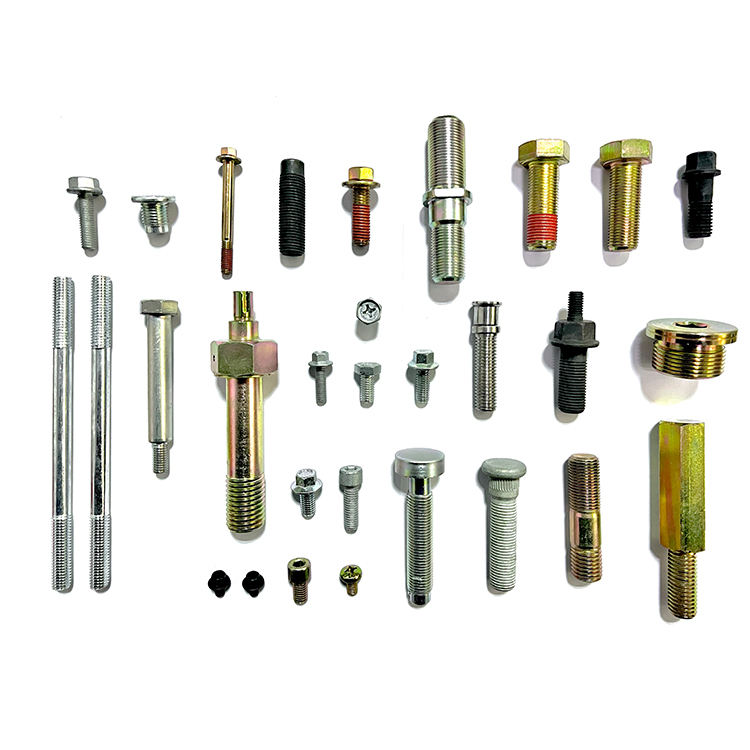
CNRL manufactures 自動車用ファスナー for vehicle applications, including bolts and other fastening components. Its automotive production covers fastener strength classes from 4.8 to 12.9, with various diameters and lengths available.
The company also maintains IATF 16949, ISO 14001, and ISO 45001 certifications. These systems support controlled production and quality management across its manufacturing operations.
For automotive applications, CNRL can work from drawings, specifications, and application requirements when developing fasteners for a specific joint.
The right preload depends on more than torque alone. Fastener grade, geometry, friction, joint stiffness, vibration, and operating conditions all have a role.
接触 CNRL’s engineering team to discuss preload specifications and automotive fastener requirements for a specific application.