OEM Vs Aftermarket Parts: What Is The Difference And Which Should You Choose?
OEM vs aftermarket parts is a choice between original-source parts and replacement-market parts. OEM parts come from the original equipment route. Aftermarket parts come from other suppliers that make parts for repair, service or replacement.
For automotive fasteners, this choice matters. A bolt, nut, washer or bushing must fit the joint. It must also match the right grade, material, coating and thread. The better option is the one that fits the job and lowers risk.
What Are OEM Parts?
OEM parts are made for the original vehicle or equipment program. OEM means original equipment manufacturer. In simple words, the part is made for the original design.
For fasteners, OEM work often starts with a drawing. The drawing may show the size, head shape, thread pitch, length, coating, grade and test need. This helps the part match the vehicle assembly.
OEM replacement parts are often used when the buyer wants the closest match to the original part. This can matter in engine, brake, chassis, suspension and transmission areas. OEM parts are usually safer when the joint is critical. But they may cost more or take longer to source.
What Are Aftermarket Parts?
Aftermarket parts are made for repair and replacement after the vehicle has already been sold. They are not sold through the original vehicle brand’s direct route.
Some aftermarket parts are made to match the original part. Others are made for lower cost, faster stock or a different repair need.
The main types include:
- Replacement parts: Made to do the same job as the original part
- Economy parts: Made for lower-cost repair
- Performance parts: Made to improve strength, weight or service life
Aftermarket parts are not always bad. Some are useful and well made. The buyer must check the real specification, not just the part name.
OEM Vs Aftermarket Parts Comparison
When comparing aftermarket parts vs OEM, do not look at price only. Look at fit, quality, warranty, supply and application risk.
| Factor | OEM Parts | Aftermarket Parts |
| Source | Original equipment route | Replacement-market supplier |
| Price | Often higher | Often lower or more flexible |
| Fit | Usually close to the original | Depends on supplier accuracy |
| Warranty | Often tied to brand or dealer support | Depends on supplier terms |
| 可用性 | Can be limited or slower | Often easier to source |
| Quality | Controlled by OEM rules | Depends on the maker |
| Best use | Critical or warranty-sensitive parts | Repair, service and cost-controlled programs |
For fasteners, a part can look the same but still be wrong. The thread pitch may be different. The coating may be weaker. The grade may not match the load.
That is why the drawing, sample and test report matter more than the label.

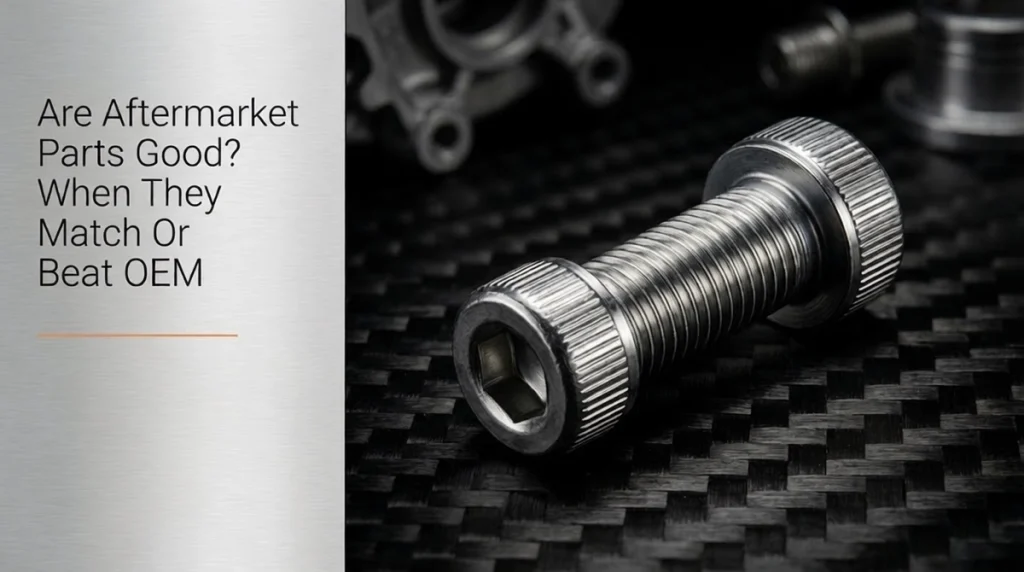
Are Aftermarket Parts Good? When They Match Or Beat OEM
Are aftermarket parts good? Yes, they can be good when they match the right drawing, material, grade, coating and test standard.
The risk is not the word “aftermarket.” The risk is poor control. A good supplier can make a part that matches the needed function. A weak supplier may only copy the size or shape.
For fasteners, aftermarket vs OEM quality should be checked through clear data. Buyers should review:
- 螺纹间距
- Size and tolerance
- Material grade
- Hardness
- Tensile strength
- Coating thickness
- Salt spray result
- Package label and quantity
Certifications also matter. IATF 16949 is useful for automotive fastener buyers because it shows that a supplier has an automotive quality system. PPAP can also help when buyers need part approval documents, samples and production records.
These checks help prove that a replacement part is not just close. It must be right for the job.
How To Choose Between OEM And Aftermarket Fasteners
Choose OEM fasteners when the part is safety-critical, warranty-sensitive or tied to strict approval rules. Choose aftermarket fasteners when the drawing is clear and the supplier can prove the part matches the need.
Use this simple check before buying:
- Cost: Is the aftermarket option worth the review time?
- Application: Is the part used in trim, body, engine, chassis or brake systems?
- Risk: Can a wrong part cause failure or service issues?
- Proof: Can the supplier provide samples and test reports?
- Supply: Is the OEM part slow or hard to find?
- Volume: Is this for one repair, bulk stock or a long-term program?
OEM is better when there is no room for doubt. Aftermarket can be better when the supplier has strong control and the buyer has the right data.
How CNRL Produces OEM-Equivalent Aftermarket Fasteners
CNRL Fasteners supports OEM and aftermarket fastener supply for automotive use. Its automotive work covers fasteners used in repair, maintenance, production and replacement programs.
CNRL can help buyers with bolts, nuts, screws, washers, clips and other automotive fastening parts. The company supports class 4.8 to 12.9 products, 3 mm to 30 mm diameters and 6 mm to 300 mm lengths for automotive fastener needs.
Testing is also important. CNRL lists checks such as hardness, tensile strength, yield, salt spray and friction coefficient testing. These checks help buyers confirm that a part fits the real job.
For buyers comparing OEM vs aftermarket parts, this is the key point: OEM-equivalent does not mean “almost the same.” It means the part should match the drawing, fit the assembly and pass the needed checks.
For repair, maintenance and replacement programs, CNRL’s automotive fastening applications page gives buyers a place to review fastener ranges, testing needs and automotive use cases before sending an RFQ.
紧固件螺栓 焊接法兰螺栓 定制焊接螺栓
更多详情常问问题
What is the main difference between OEM and aftermarket parts?
The main difference is the source. OEM parts come from the original equipment route. Aftermarket parts come from replacement-market suppliers. For fasteners, buyers should also compare size, thread, grade, material and coating.
Are aftermarket parts good for car repairs?
Yes, aftermarket parts are good for car repairs when they match the right specification. A good aftermarket fastener should match the original part’s thread, size, grade, coating and working condition.
Are OEM replacement parts always better?
OEM replacement parts are not always better for every case. They are often safer for critical repairs. But a tested aftermarket part can work well when the supplier proves the part matches the job.