Anti-Seize vs Threadlocker: How Do Anti-Seize Compounds and Threadlockers Alter Bolt Friction Coefficients and Torque Calculations?
Quick Answer:
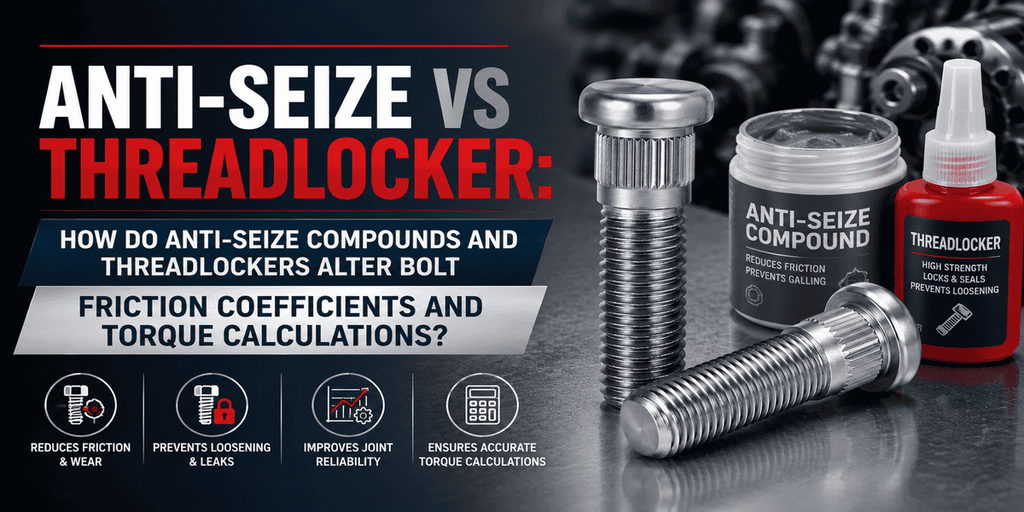
Anti-seize and threadlocker deal with different fastener issues. The use of anti-seize reduces friction and prevents corrosion or galling. The threadlocker is utilized to provide resistance to any unwanted movement of the threads. This is also one of the reasons why their effects on torque values differ. Using anti-seize on bolts can reduce friction between the threads, and therefore, using the same torque can increase bolt tension compared to the use of dry threads.
The use of thread locker can also influence the friction value during assembly depending on its type and condition. Therefore, torque values need to be appropriate according to the specified thread condition. The dry torque value cannot be automatically considered when lubrication or chemical treatment is used. CNRL produces automotive fasteners for engines, chassis, transmissions, brakes, among others, in vehicles.

Why do anti-seize and threadlocker serve opposite purposes?
The distinguishing factor when comparing anti-seize vs threadlocker can be found in how the joint behaves.
Anti-seize aids future removal of the joint. It coats the metals with a lubricant and protects the parts from getting stuck.
Threadlocker does something else entirely. It fills in the gaps within the mating threads and gets cured once assembly has taken place. It prevents any unwanted movement, especially if vibrations may cause loosening.
Both of these products affect the conditions within the threads. This means that none of them should be applied lightly to an automotive torque-controlled joint.
Friction changes bolt tension
The torque force is not used for stretching of bolts. The torque force is partially consumed in overcoming friction in the threads and under the bolt head or nut.
Reduced friction results in increased force for the tensioning of bolts. When the lubrication changes but torque remains constant, the preload will be out of acceptable limits. That is why the condition of threads must be included in the torque specification.
What is anti-seize and when should it be used?
Anti-seize is a lubricating compound applied to threaded or fitted metal surfaces. Its main purposes are to reduce galling, limit seizure, and make later disassembly easier. Knowing when to use anti-seize depends on the material and service conditions. It can be useful on fasteners exposed to heat, moisture, corrosion, or repeated removal.
Effect on torque calculations
Using anti-seize on bolts changes the friction between mating threads. The same effect can occur beneath a bolt head or nut if the compound reaches the bearing surface.
Because friction falls, applying the original dry torque can produce higher preload than expected. In some cases, this can overstress the bolt, threads, or clamped component.
Torque should therefore be adjusted according to the approved torque specification rather than using a universal correction factor.
What is threadlocker and when should it be used?
Threadlocker is a chemical compound applied to mating threads before assembly. Many types cure after the fastener is installed and help resist rotation. This makes threadlocker for automotive joints useful where vibration or repeated movement could contribute to loosening.
Common examples can include selected engine accessories, brackets, drivetrain parts, and chassis components. Whether threadlocker is required depends on the vehicle manufacturer’s joint specification.
Controlling vibration-induced loosening
Knowing when to use threadlocker starts with understanding why the joint might loosen. A correctly tightened bolt creates preload that holds the joined surfaces together. If transverse vibration produces enough movement between those surfaces, clamp force can decrease, and the threaded connection may begin rotating.
Threadlocker adds resistance to this unwanted thread movement. However, it does not correct poor bolt selection, damaged threads, or an incorrect tightening procedure. Its effect on assembly friction must also be considered when establishing torque requirements.
Why should anti-seize and threadlocker generally not be used together?
The basic rule is straightforward: do not combine them unless the approved joint specification specifically calls for that combination.
Anti-seize is intended to lubricate the threaded surfaces. Threadlocker needs suitable contact with the mating threads so it can perform as specified.
Mixing the two can interfere with the intended behavior of either product. It can also make the resulting friction condition harder to predict.
This is the practical answer behind many Loctite vs anti-seize comparisons. The decision should not be based on which product is stronger. It should be based on what the joint needs.
Lubrication or locking
For a fastener exposed to heat and likely to require later removal, the specification may call for anti-seize. For a vibration-sensitive joint where unwanted rotation is the main concern, it may specify threadlocker.
Understanding when to use anti-seize and when to use threadlocker prevents one product from being used to solve the wrong problem.
Where are anti-seize and threadlocker used in automotive applications?
Automotive joints operate under very different temperatures, loads, vibration levels, and maintenance requirements. No single thread treatment is suitable for every bolt.
Exhaust and high-temperature joints
Exhaust hardware experiences heat, corrosion, and repeated thermal cycling. Where the manufacturer permits it, anti-seize may help prevent threads from seizing during future removal.
The approved torque procedure still matters because the compound changes friction.
Engine and drivetrain assemblies
Some engine and drivetrain joints require carefully controlled friction to reach the intended preload. Adding an unapproved lubricant can change that relationship. Other joints may specify threadlocker for automotive assembly because vibration resistance is important. The fastener drawing or service procedure should determine the treatment.
Chassis and serviceable components
Suspension and chassis fasteners can experience vibration, water, dirt, and road salt. Depending on the design, engineers may use coatings, locking features, chemical threadlocker, or other methods. This is another reason the Loctite vs anti-seize question has no universal answer. Joint design and service requirements determine the appropriate approach.
Automotive Engine Fasteners
詳細情報How are CNRL bolts designed for proper lubrication and friction control?
Bolt material and strength are only part of a torque-controlled joint. Surface treatment and friction also affect how tightening torque becomes preload.
CNRL produces 自動車用ファスナー from performance class 4.8 through 12.9. Its available surface treatments include zinc finishes, phosphating, trivalent chromium, Dacromet, oxidation, and other treatments based on customer requirements.
CNRL also lists friction coefficient testing among its automotive fastener quality checks. This matters because 表面処理 can change the friction conditions used when determining assembly torque.
For OEM and custom projects, fastener dimensions, material, coating, surface requirements, and assembly conditions can be specified together. This approach helps avoid treating torque as an isolated value.
The same principle applies when comparing anti-seize vs threadlocker. The thread treatment must be considered together with the bolt and the required preload.
For projects that require a locking compound as part of the supplied fastener specification, application requirements should be confirmed during sourcing. CNRLにお問い合わせください to discuss pre-applied threadlocker fasteners and the required friction, coating, and torque specifications for automotive assemblies.